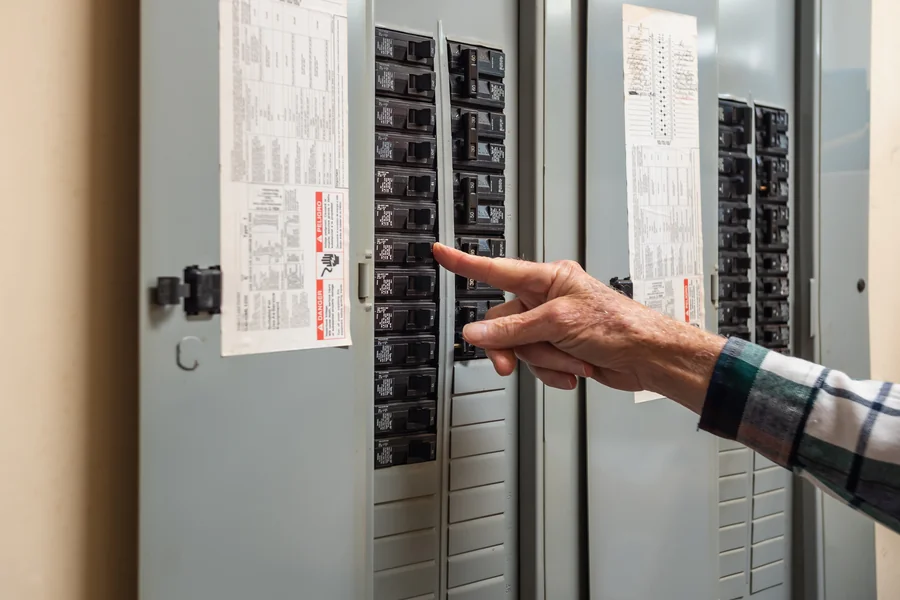
The car arrives in three weeks. The charger is already sitting in a box by the garage door. And somewhere on an owners’ forum, someone has assured the new EV buyer that none of it will work until they spend a few thousand dollars upgrading their electrical panel. Is that actually true?
Sometimes. Often not. Alexandr Godonoaga, owner of Cob Services LLC and an ICC-certified EV charger installer in the western Chicago suburbs, fields this question almost every week. His answer is the one nobody wants and the only honest one: it depends, and finding out takes about twenty minutes with the panel door open.
Start with the charger you actually want
Most of the panel worry comes down to which kind of charging a homeowner is after. Level 1 charging uses the 120-volt outlet already in the garage and adds roughly three to five miles of range an hour. It’s slow, but for someone with a short commute or a plug-in hybrid, it’s often enough, and it usually needs no electrical work at all.
Level 2 is the one that raises the question. It runs on 240 volts, the same kind of circuit a clothes dryer uses, and adds somewhere around twenty to forty miles of range an hour depending on the charger. “Almost everybody who calls me wants Level 2,” Godonoaga said. “It’s the difference between waking up to a full battery and never quite catching up. But it needs its own dedicated circuit, and that’s where the panel comes into it.”
The real answer comes from a load calculation
Here’s the part the forum threads skip. A good electrician doesn’t decide by glancing at the panel and guessing. They do a load calculation: they add up what the home already demands and see how much capacity is left for a charger.
“I’m not just reading the number stamped on the panel,” Godonoaga explained. “I’m adding up what the house actually pulls. The air conditioning, the range, the dryer, the water heater. Then I see what’s left over. That leftover is what tells me whether we can drop in a 50-amp circuit safely or not.”
It matters that an EV charger is what the code calls a continuous load, because it runs for hours at a stretch. That’s why a 40-amp charger gets wired on a 50-amp circuit, with the extra headroom built in. Skip that math and you get nuisance trips at best, and an overheated panel at worst.
When your panel is probably fine as-is
The good news is that plenty of homes need no upgrade. A house with 200-amp service and gas heat, a gas range, and a gas dryer is usually carrying a light electrical load, which leaves room to spare. Even some 100-amp panels can take a Level 2 charger when the rest of the house isn’t demanding much.
“A lot of the time we’re just running a new circuit and mounting the charger. No drama,” Godonoaga said. “People brace themselves for a huge bill and then it turns out their panel had plenty of room the whole time.”
When an upgrade is the right call
The opposite case is an older 60- or 100-amp panel that’s already close to full, especially in an all-electric home running an electric range, an electric dryer, and central air. Add a fast charger on top of that and the panel is being asked to do more than it was built for.
“If the box is already full and everything in the house runs on electricity, a fast charger is one demand too many,” he said. “That’s when an upgrade earns its keep. And it’s usually a good moment to do it anyway, because you’re future-proofing the whole house, not just the car.” A panel or service upgrade in the area tends to run a few thousand dollars, depending on the amperage and whether the meter base and grounding need work.
The middle option most people never hear about
This is the piece of advice that surprises homeowners. A full panel upgrade isn’t the only way to add a charger to a tight panel. There’s a category of energy management devices, sometimes called load management or a smart splitter, that lets a charger share an existing high-power circuit or automatically dials the charging back when the rest of the house gets busy.
“There’s a middle path people don’t hear about,” Godonoaga said. “We can put in a device that throttles the charger when the dryer and the oven are both running, then lets it ramp back up overnight. The National Electrical Code recognizes these, and sometimes it saves a homeowner the cost of a full upgrade. It isn’t right for every house, but it’s worth asking about before you assume the worst.”
Costs, permits, and the right order of operations
Two things tend to get rushed. The first is the permit. An EV charger installation and a new 240-volt circuit usually call for a permit and an inspection, which is there to confirm the work and the load are sound, not to slow anyone down. A licensed installer handles that as part of the job.
The second is the order in which all this happens. The cleanest path is to get the load calculation before buying the charger, not after. Before clicking buy on a high-powered 48-amp charger, homeowners around Downers Grove and the western suburbs often have residential electricians run the load calculation first, so the charger they order is one the panel can actually support.
“The disappointed customers are almost always the ones who bought the biggest charger they could find, then called me,” Godonoaga said. “Five minutes on the phone first, and we’d have matched the charger to the house. Figure out what the panel can do, then buy the equipment that fits it. Not the other way around.”
Alexandr Godonoaga is the owner of Cob Services LLC, an ICC-certified EV charger installer and licensed electrical contractor serving Downers Grove and the western Chicago suburbs (Illinois license #26-00032356).