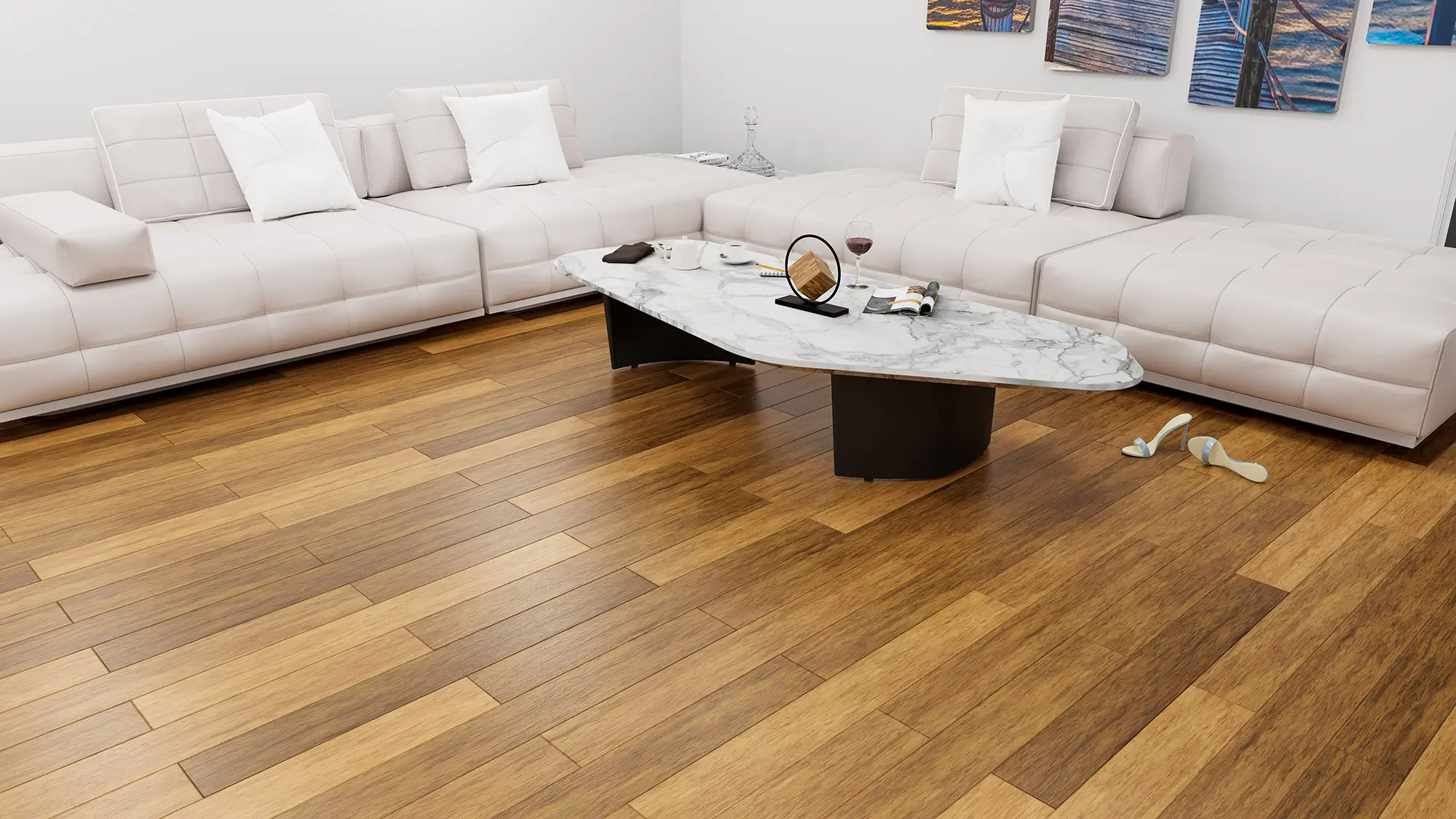
I went into my conversation with Mario Vilchis assuming he’d tell me to put hardwood in before selling. He installs the stuff. It’s in his company’s name. So his first answer surprised me a little: “Depends what you’re trying to do. If you’re selling, sometimes the smart floor is the cheap one done well.”
Mario runs Vilchis Hardwood Floors, a family-owned company in Durham, North Carolina that’s been putting floors in Triangle homes since 2010. He sees a lot of pre-sale jobs, the kind where somebody’s listing in six weeks and the carpet in the bedrooms is shot. Those homeowners want one thing answered honestly: what flooring move actually helps the sale without setting money on fire. I asked him to lay it out, and he was more candid than I expected.
The buyer-walks-in problem
Mario’s whole case starts with the first ten seconds of a showing. “A buyer walks in, looks down, and either the floor reads as taken care of or it reads as a project,” he said. “That’s it. That’s the whole reaction. They’re not pricing out per-square-foot anything in their head. They just feel handled or they feel hassle.”
Tired carpet, he says, reads as hassle louder than almost anything else in a house. Stains, matted traffic lanes, that smell older carpet gets. A buyer sees it and mentally starts subtracting. And here’s the part Mario thinks sellers miss: the buyer almost always subtracts more than the floor would actually cost to replace. “Somebody sees ratty carpet and knocks ten grand off in their head for a job that’s four,” he said. “You’re losing money to a feeling.”
Where laminate wins on a sale
This is where he made the case for laminate, and the link he kept coming back to was speed and consistency. When you’re staging a house to sell, laminate flooring does a specific job well: it covers a lot of square footage fast, it photographs like wood, and it gives the whole main level one clean continuous look that buyers register as updated.
The math is the other half. Mario put rough Durham numbers on it. Hardwood installed runs somewhere around eight to fifteen dollars a square foot all in. Laminate runs three to eight. On a house where you’re redoing a thousand square feet before listing, that gap is real money, and the seller doesn’t get to keep the house long enough to enjoy the nicer floor anyway. “You’re not living on it,” he said. “You’re selling on it. The buyer gets the wood floor’s lifespan, not you. So why pay for it?”
Speed matters more than people expect, too. He pointed out that laminate is mostly click-lock, no sanding, no finish curing for days. A crew can do a single level in a day or two, which fits the compressed timeline a listing usually runs on. Hardwood, especially site-finished, ties up the house longer right when you need it photo-ready.
When he tells sellers not to do it
Here’s the part that made me trust the rest. Mario does not think laminate is the answer for every sale, and he said so plainly.
If the house already has original hardwood under the carpet, his advice flips completely. “Don’t you dare cover that,” he told me. “If there’s real oak under there, pull the carpet and refinish it. In an older Durham home that’s a selling point, not a cost. Buyers around here pay for original floors.” He’s pulled up carpet in Trinity Park and Forest Hills bungalows and found hardwood that just needed a sand and a coat, and covering it with laminate would have been the wrong call by a mile.
He’s also honest that in a higher-end home, or a neighborhood where every comparable listing has real wood, laminate can read as a downgrade to the buyers shopping that price band. The floor has to match the expectations of the people walking through. “Read the room, literally,” he said. “A starter home in a flip, laminate is perfect. A four-hundred-thousand-dollar renovation, maybe not.”
And he won’t put laminate in a full bathroom or laundry room to chase a uniform look, because it’s water-resistant, not waterproof. For wet rooms he’d use luxury vinyl plank instead, even on a pre-sale job, because a buckled bathroom floor at the inspection is worse than no upgrade at all.
The mistake he sees most
I asked what sellers get wrong. He didn’t hesitate: they buy the cheapest laminate on the shelf and have it installed badly, or install it themselves, to save a few hundred dollars.
“The look of laminate has come a long way, but only the decent stuff,” he said. “The bottom-tier planks still look like plastic, and a buyer can tell.” Worse, he says, is a rushed install: gaps at the walls because nobody left an expansion gap, a hollow sound underfoot because the underlayment got skipped, seams that don’t line up. “Now the floor reads as cheap *and* sloppy, which is worse than the carpet you replaced. You’ve spent money to make a worse impression.” His point was that the upgrade only works if it actually looks like an upgrade.
So what should a seller take from this
By the end of the call, Mario’s position was clearer than the simple yes I’d expected, and more useful. Laminate is a smart pre-sale move when you’ve got worn-out carpet, a tight timeline, and a price point where buyers want clean and updated more than they want premium. It’s the wrong move when there’s salvageable hardwood underneath, when the comps all show real wood, or when it gets done on the cheap.
What I kept thinking about afterward was that none of his advice pushed me toward the bigger job. The guy who’d profit most from selling me hardwood spent half an hour explaining when not to buy it. For a seller trying to make a smart, unsentimental call before a listing, that’s the kind of read worth having.