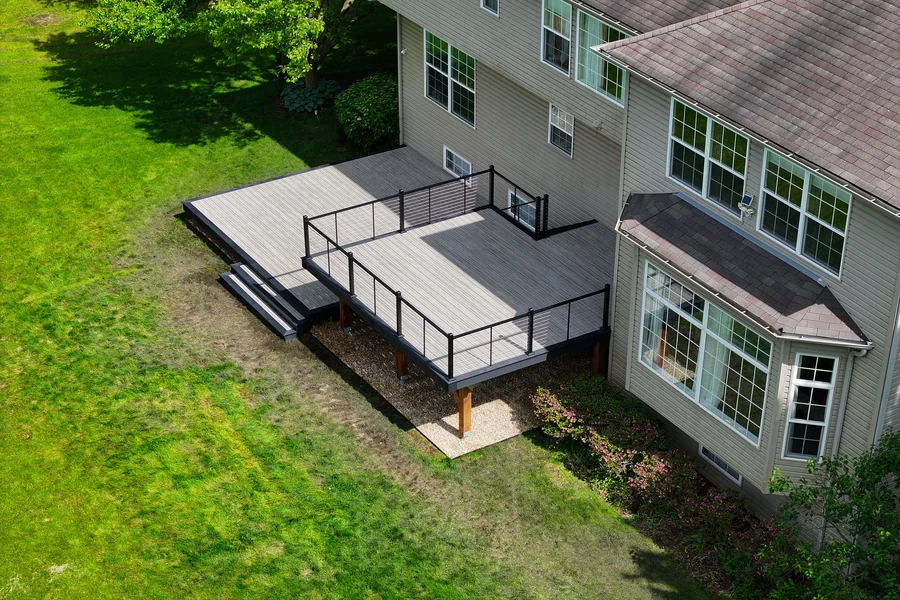
If you hired someone to build a deck in Naperville last year and they handed you a clean set of drawings, there’s a decent chance those drawings are already out of date. Not because anyone did anything wrong. The rules moved.
I spend a lot of time writing about home projects in the western suburbs, and decks are the one where the gap between “looks finished” and “passes inspection” is widest. A deck can look beautiful and still fail. So when I wanted to understand what actually trips people up here, I called Radu Oprea, who runs a Naperville deck builder that pulls permits in the city most weeks of the year. His answer was not what I expected. The thing contractors skip most often, he said, is not a bolt or a bracket. It’s a calendar date.
Naperville changed its deck code on April 1, 2026
Here’s the part that catches people. For years, Naperville’s deck rules grew out of the 2021 International Residential Code, the edition that gave decks their own dedicated chapter, Section R507. That section pulled deck framing, footings, ledger connections, and railings out of the general-construction language and spelled them out on their own. It was a real step forward for anyone who builds these things.
Then on February 17, 2026, the City Council adopted the 2024 ICC codes. Any permit submitted on or after April 1, 2026 has to follow the 2024 edition. The deck provisions did not get torn up and rewritten. Most of R507 carried straight across. But a few details tightened, and that’s where the trouble starts.
“I still get calls from homeowners holding a quote that was drawn to the old code,” Radu told me. “The crew isn’t being dishonest. They just haven’t read the new ordinance yet. The plan reviewer has.”
If you’re getting bids right now, this is the first question to ask a contractor: are your drawings to the 2024 IRC? If they hesitate, you have your answer. Everything below applies under both editions, because these are the details that get skipped regardless of which code year is stamped on the permit.
The footing depth that fails more inspections than anything else
In Naperville, deck footings have to reach at least 42 inches below grade. That number comes from the local frost line, and it is not negotiable. Northern Illinois ground heaves when it freezes, and a footing that stops short will lift a corner of your deck a little more every winter until the whole thing racks out of square.
Forty-two inches is deeper than a lot of out-of-town crews expect. I’ve watched augers come up out of clay at 30 inches and a foreman shrug like that’s plenty. It isn’t, and the inspector knows it, which is why Naperville requires a footing inspection before any concrete goes in. Someone from the city looks in the holes. If they’re shallow, undersized, or in the wrong spot, you backfill nothing and start over.
The size of the footing matters as much as the depth. R507 ties footing diameter to how much deck each post carries, the tributary area, and the bearing capacity of your soil. A corner post holding up a small landing needs less than a center post under a wide span. Plan reviewers in Naperville want that math shown on the drawing, with the depth, the diameter, the post size, and the hardware all called out. Hand-wave it and the plans come back with comments.
The ledger connection nobody photographs
If a deck is going to hurt someone, it usually happens at the ledger, the board that fastens the deck to the house. Collapses almost always trace back to that joint. The code treats it that way.
A proper ledger is bolted to the home’s rim joist with lag screws or through-bolts in a specific pattern, never with nails and never with deck screws. The fasteners have to land in solid framing, not just the sheathing. And the whole assembly needs flashing that sends water away from the house instead of trapping it against the band joist, where it rots quietly for a decade.
Radu said the flashing detail is where he sees the 2024 code starting to bite. “The new edition is more specific about how the deck attaches to the house and how that joint sheds water,” he said. “We updated our standard ledger detail months ago. I expect reviewers to start kicking back drawings that show the old method.” Flashing is invisible once the decking goes down, so nobody takes a picture of it and nobody brags about it. It’s also the difference between a deck that lasts 25 years and one that quietly fails behind the siding.
Lateral load: the two brackets that cause arguments
This is the one that gets the most pushback from older builders. A ledger handles the weight pressing down. It does not, on its own, stop the deck from pulling away from the house when a crowd shifts toward the railing. For that, the IRC wants a lateral load connection: tension ties that run from the deck framing through the house’s floor system, rated to hold real force, typically two devices at no less than 1,500 pounds each.
I’ve heard contractors call these unnecessary. They are wrong, and more to the point, the inspector won’t sign off without them. Retrofitting hold-downs after the framing is up and the decking is on is miserable work, because the hardware is designed to be installed while the floor framing inside the house is still reachable. Skip it at framing and you may be pulling up boards later. Plan for it from the first drawing.
Guards and stairs, where the tape measure earns its keep
Once a walking surface sits more than 30 inches above the ground, you need a guard. In Naperville that guard has to be at least 36 inches tall, and the openings have to be tight enough that a 4-inch sphere can’t pass through. The 4-inch rule exists for a blunt reason: a small child’s head. Inspectors carry the sphere and they use it.
Guards also have to take a beating. The code expects a railing to resist a 200-pound force pushing out at the top, and the infill to hold up under load too. Radu mentioned that the 2024 edition tightened the concentrated-load test on guards, which means the bracket-and-post connections that passed under older rules deserve a second look. A railing that wobbles when you lean on it isn’t going to pass, and frankly it shouldn’t.
Stairs have their own list. Risers max out at 7 and three-quarter inches, treads run at least 10 inches deep, and every riser and tread on a flight has to be within three-eighths of an inch of the others, because uneven steps are how people fall. Handrails sit between 34 and 38 inches and have to be graspable, an actual shape your hand can close around, not a wide flat 2×6 cap.
Fasteners, the boring detail that rots decks early
Modern pressure-treated lumber is more corrosive to metal than the old stuff. Use the wrong hardware and your connectors rust from the inside while the wood around them looks fine. The code calls for hot-dipped galvanized or stainless steel fasteners, hangers, and connectors rated for contact with treated wood. A box of cheap deck screws from the wrong shelf can cut years off a structure that otherwise would have outlived its owner.
None of this is exotic. It’s the kind of thing a careful builder does without being asked. The trouble is that “careful” and “cheapest bid” rarely show up in the same truck.
Why any of this matters when you go to sell
A permit isn’t bureaucratic theater. In Naperville, deck work shows up in the property record, and unpermitted or non-conforming work has a way of surfacing during a sale, sometimes years after the deck was built. A buyer’s inspector flags it, the deal stalls, and suddenly you’re paying to tear out and rebuild a deck that’s been fine to sit on but was never legal. The footing inspection you grumbled about is the same paperwork that lets you tell a buyer the structure is sound and signed off.
So if you’re planning a deck this season, the homework is short. Confirm the bid is drawn to the 2024 IRC. Ask how deep the footings go and watch for the number 42. Ask to see the ledger flashing and lateral-tie detail on the drawings, not just hear about it. And make sure the permit gets pulled through the city’s Civic Access portal with a real footing inspection scheduled before anyone mixes concrete.
The crews that do this well don’t treat the code as an obstacle. They treat it as the floor, the lowest acceptable version of the work, and then they build above it. The ones who skip these details aren’t usually cutting corners on purpose. They just haven’t kept up. In a town that changed its rules on April 1, keeping up is the whole job.
The author writes about residential construction and home improvement in the Chicago suburbs. Code details in this article reflect Naperville’s adoption of the 2024 ICC codes effective April 1, 2026; always confirm current requirements with the City of Naperville building department before starting work.